Yours, Critically
Most designers critique alone. This AI design critic pushes back so your users don't have to.
Overview:
Yours, Critically is an AI-powered design critique tool that helps designers identify blind spots in their decisions. Instead of providing generic feedback, the system challenges assumptions, highlights risks, and surfaces trade-offs to encourage deeper thinking.
This AI agent is designed to feel less like a chatbot and more like a structured critique partner. It guides users through a focused interaction: describe a decision, receive a critique, and iteratively challenge the output up to a defined limit.
The goal is to shift designers from seeking validation to engaging in critical reasoning.
The Problem:
Design decisions get made in isolation every day. A junior designer submits a flow without anyone questioning the assumptions baked into it. A solo designer at a startup ships a feature without a single senior voice pushing back. The feedback comes later, from users, from metrics, from stakeholders in a review meeting.
By then, it's expensive to fix.
The problem isn't skill. It's access. Not every designer has a senior critic in the room. Not every team has the bandwidth for rigorous design review. And most AI tools don't help — they generate, suggest, and summarise. None of them challenge.
Yours, Critically was built to fill that gap.
The product is simple on the surface: describe a design decision, receive a structured critique. But the thinking behind it is deliberately opinionated. Every element, the tone system, the output structure, the follow-up depth ladder, the confidence scoring, was designed to make the critique feel trustworthy, not just fast.
Product Desicions:
The Name
The comma is intentional. It creates a pause, like a considered thought before a difficult truth.
The Tone
Most AI tools default to supportive, overly agreeable language.
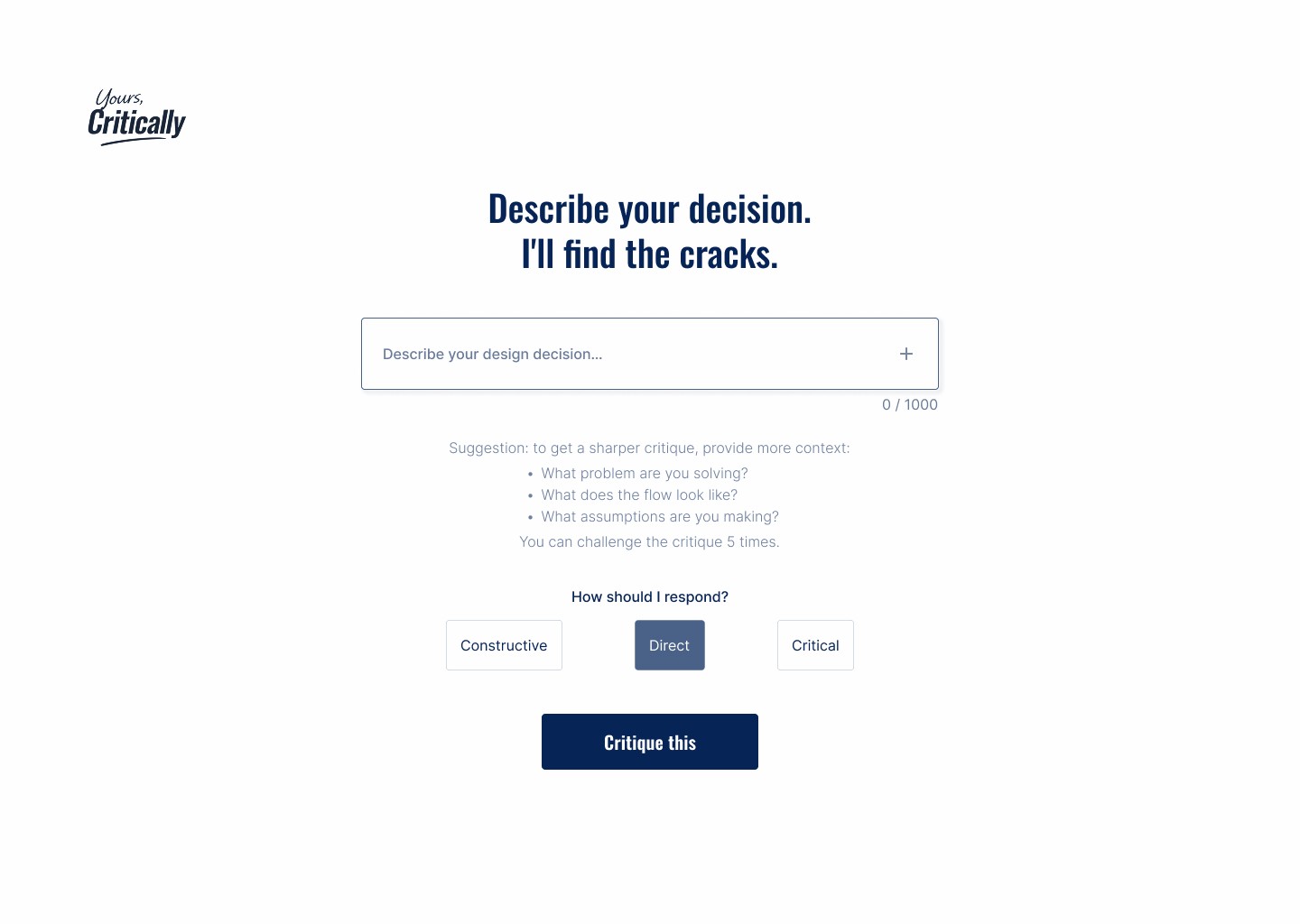
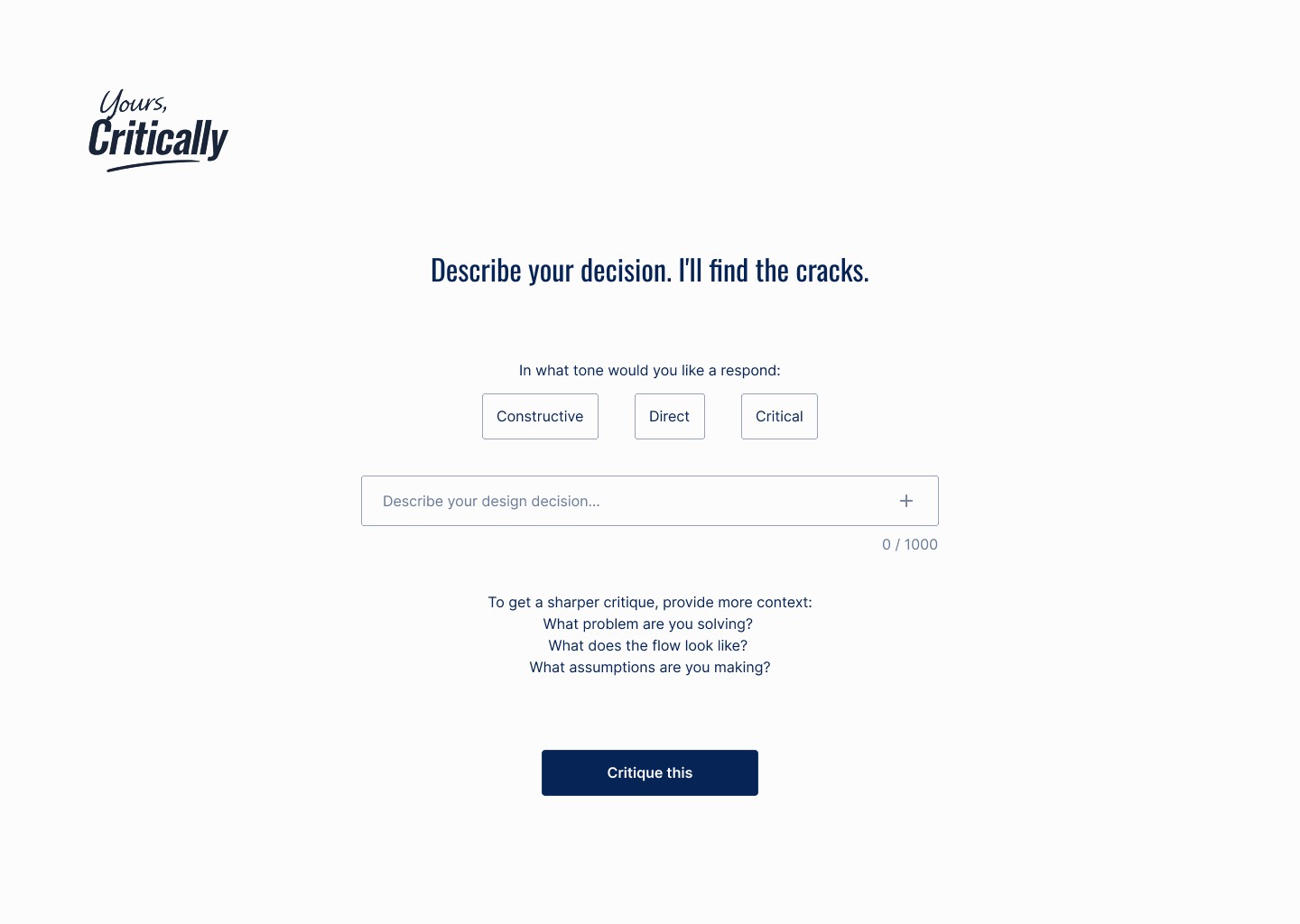
The tone here is intentionally: Constructive, Direct, and Critical. Each shifts the register of the output without changing the structure. The analysis stays the same. The delivery changes.
Interaction Model
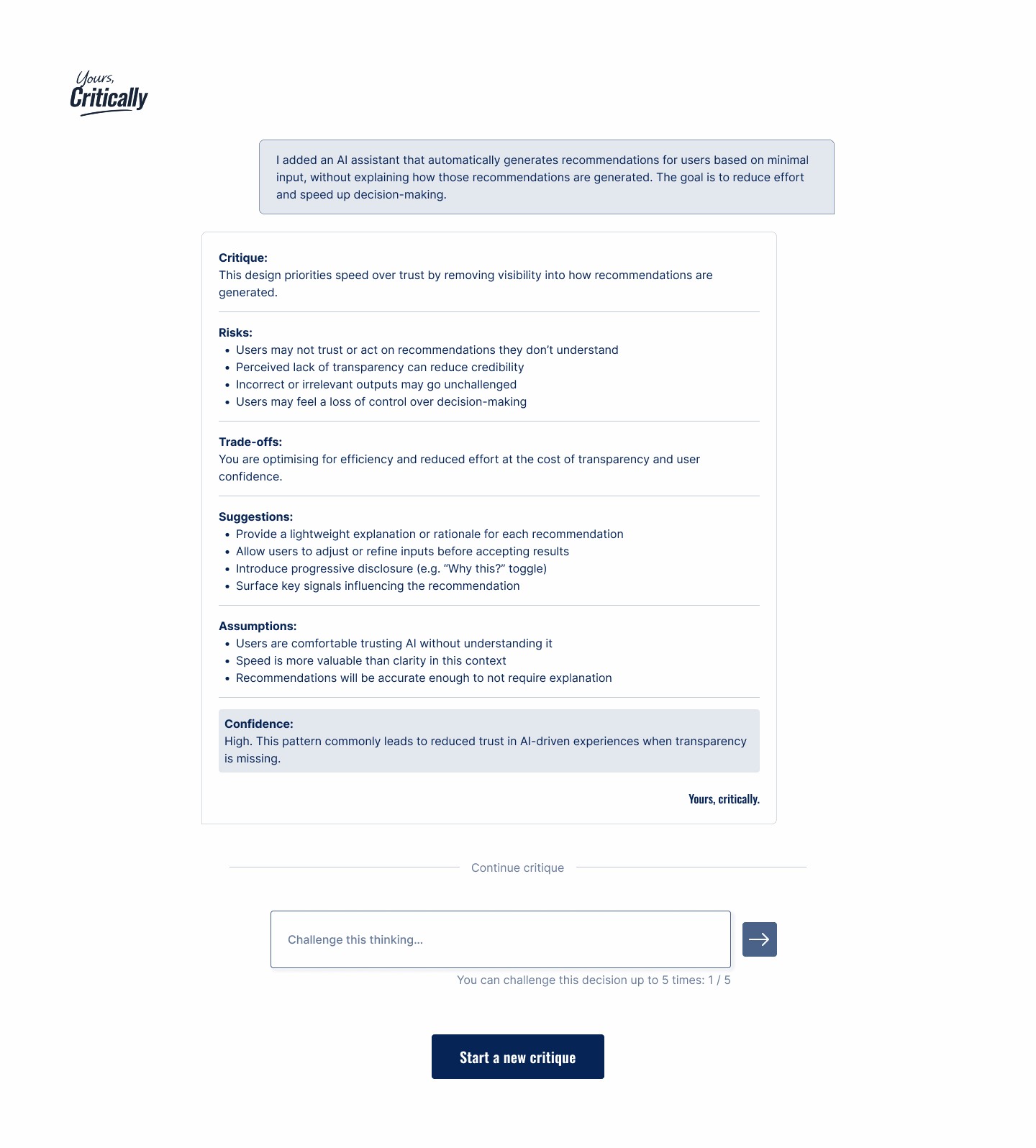
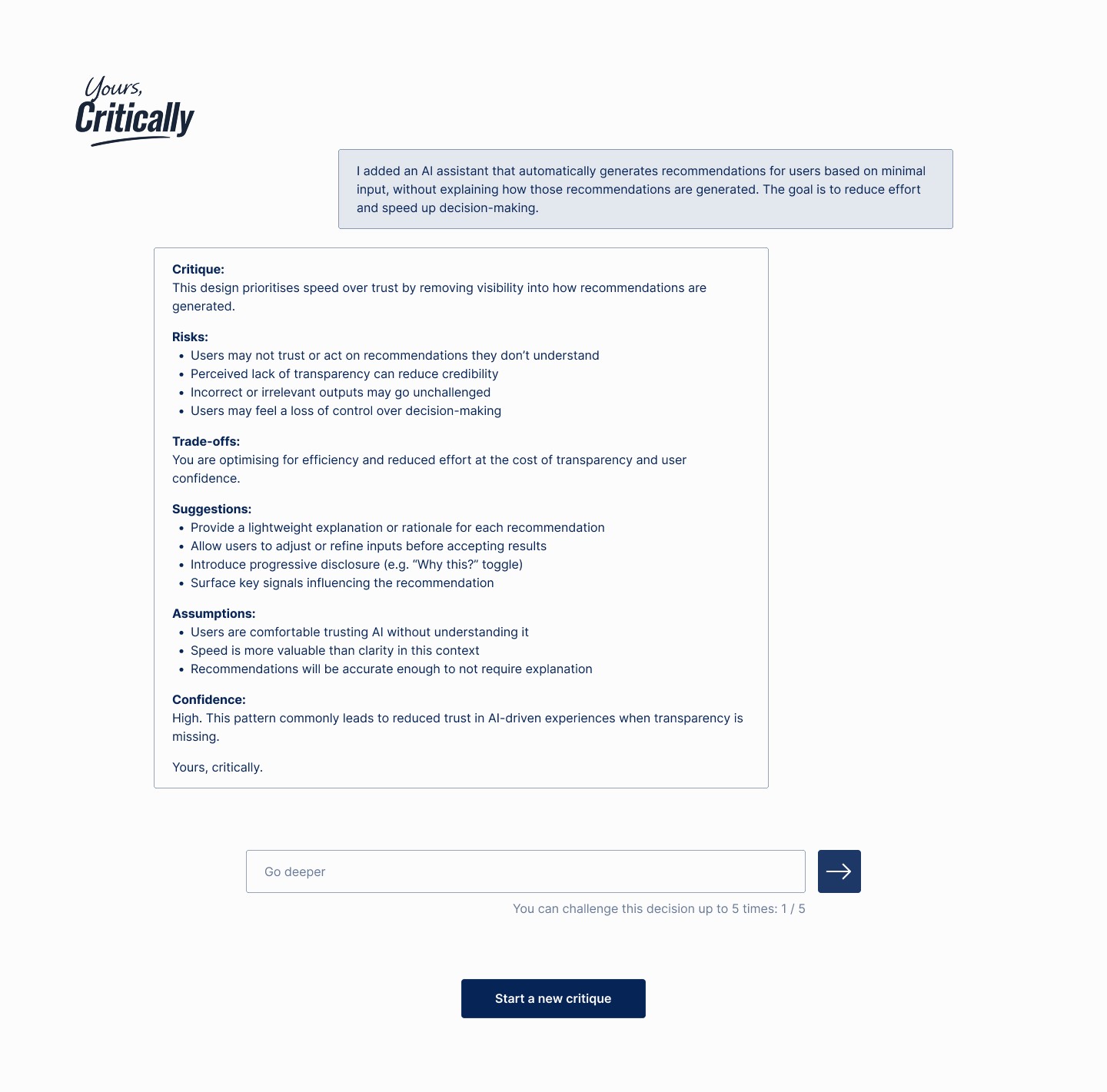
Most AI tools default to a chat interface because it is familiar. Yours, Critically was designed against that instinct. It is structured as a document, not a conversation.
Six sections: Critique, Risks, Trade-offs, Suggestions, Assumptions, Confidence.
This makes the output scannable, actionable, and credible.
The chat layer exists below the document, separated by a "Go deeper" divider.
Users can follow up up to five times. After that, the system prompts them to start a fresh perspective.
This constraint is intentional: it prevents the tool from drifting into an unstructured chatbot and preserves the quality of the critique.
Confidence scoring
Most AI feedback tools give you output with no indication of how reliable it is. Yours, Critically surfaces a confidence score with every critique: High, Medium, or Low, with a one-sentence explanation of what drove that score.
The score is tied to three factors: input clarity, pattern familiarity, and assumption level.
A vague input produces a lower confidence score and tells the user why. This directly improves input quality over time, and makes the critique feel earned, not generated.
The signature
Every output ends with "Yours, critically." It is a brand moment, not a UI element.
The Process:
Product Thinking
The first phase was entirely about definition. Not wireframes, not colours, decisions.
Who is this for? A solo product designer at a startup, 1-5 years in, working without a senior feedback loop. What is the single most painful moment? Staring at a design decision you've made alone, unsure if it holds up, with no one to challenge it.
AI Prompt Design
A three-step reasoning chain was designed explicitly into the prompt:
Interpret: identify the goal, the flow type, and the likely user context.
Analyse: detect hidden assumptions, identify UX patterns, consider failure scenarios.
Generate: produce a structured critique in a fixed format, grounded in steps 1 and 2.
This separation of reasoning from output prevents the most common AI failure: generic feedback that could apply to any design.
The follow-up behaviour was also designed explicitly, not left to chance. Each of the five follow-up turns deepens the critique on a defined ladder:
Clarifying → Pressing → Stress-testing → Reframing → Concluding.
Design
The design system was built around a monochromatic blue palette: #062456 as the primary, #4A6188 as secondary, #ADB9CB for muted elements, #E3E7EE for surfaces. Oswald for headings, Inter for body.
The visual direction was editorial, not app-like. More document than dashboard. More letter than chatbot. Every spacing decision, typography choice, and colour application was made to reinforce that feeling.
Wireframes came before high fidelity. High-fidelity screens were designed in both Figma and Claude Design, then used as the reference for the build in Replit.
Build
The Result:
Yours, Critically intentionally has no onboarding, no dashboard, no account creation. You arrive, you describe a decision, you receive a critique.
Replit
What I Learned: